

Last checked: 14 October 2026
After completing Umrah, many pilgrims want to spend a few hours seeing the places around Makkah that are connected with the life of the Prophet ﷺ and with the rites of Hajj. This guide is about planning that day: which places are usually included, how to group them by area so you are not criss-crossing the city, what to expect at each stop, and how to arrange transport. For background and history on each place, see our Makkah Ziyarat pages.
Before you plan: what a Makkah Ziyarat day is (and is not)
Visiting these places is not part of the rites of Umrah. Our location pages describe Jabal al-Nour as a historical site where climbing is not part of Umrah or Hajj, and note that Arafat, Muzdalifah and the Jamarat are Hajj sites that can be seen on a Ziyarat tour outside the Hajj season. The Ministry of Hajj and Umrah’s Umrah and Visit Guide simply encourages visitors to explore the historical and cultural sites of Makkah to enrich their journey. Treat the day as learning and reflection, follow the signs and instructions at each site, and ask a qualified scholar if you have a religious question.
The places most Makkah Ziyarat tours include
The easiest way to plan is by area. Most stops fall into three groups: the north-east (Jabal al-Nour), the south (Jabal Thawr) and the east (the Hajj sites of Mina, Muzdalifah and Arafat). Museums are an optional extra.
North-east: Jabal al-Nour, Cave Hira and the Hira Cultural District
Jabal al-Nour is a steep mountain in the north-east of Makkah. Near its summit is the Cave of Hira, where the first verses of the Qur’an were revealed. The climb is steep and takes most people roughly an hour or more each way, and the cave itself is small and often crowded.
At the foot of the mountain is the Hira Cultural District. According to the Pilgrims Experience Program, its Revelation Exhibition uses digital displays and audiovisual presentations to explain the story of the first revelation. The exhibition has its own opening hours and tickets, so check the official information before you go. For many families, the exhibition plus a view of the mountain from below is a practical alternative to the climb.
South: Jabal Thawr
Jabal Thawr, to the south of Makkah, holds the Cave of Thawr, where the Prophet ﷺ and Abu Bakr al-Siddiq hid for three nights at the start of the Hijrah to Madinah. The climb is long and steep — plan for several hours in total if you go up. Many visitors instead view the mountain from its base as one stop on a Ziyarat drive.
East: Mina, Muzdalifah and Arafat
These are the sites of Hajj, and outside the Hajj season they are usually seen from the vehicle with short stops:
- Mina — a valley a few kilometres east of Masjid al-Haram, known for its fields of permanent white tents. It contains the Jamarat Bridge and Masjid al-Khayf. Outside Hajj it is largely empty; during Hajj, access is limited to permitted pilgrims. Masjid al-Khayf is often closed outside the Hajj season.
- Muzdalifah — between Mina and Arafat, where Hajj pilgrims spend the night after the Day of Arafah. It is seen on the drive between the two.
- Arafat — a wide plain about 20 km south-east of Makkah, with the small hill of Jabal al-Rahmah. Climbing Jabal al-Rahmah is not a rite of Hajj. Masjid Namirah, on the western edge of Arafat, is normally opened mainly for the Day of Arafah and can usually be seen from outside.
Optional: Makkah museums
Our Makkah museums page covers the Exhibition of the Two Holy Mosques Architecture, the King Abdulaziz Complex for the Holy Kaaba Kiswa and the Revelation Exhibition. Opening days, hours and booking rules differ and change from time to time, and some visits (especially the Kiswa complex) need prior arrangement — so confirm before adding them to your day. The Ministry’s guide also recommends the museums around the Two Holy Mosques for learning about their history.
Two sample ways to order your day
These are planning examples, not fixed packages. The right order depends on where your hotel is, traffic, prayer times and who is travelling with you.
Option A — a short drive (no climbing). Start early from your hotel, drive east through Mina and Muzdalifah to Arafat and Jabal al-Rahmah, then head south to see Jabal Thawr from its base, and finish in the north-east at Jabal al-Nour and the Hira Cultural District before returning to your hotel. Grouping the Hajj sites together avoids crossing the city twice.
Option B — a climb plus a shorter drive. If someone in your group wants to climb Jabal al-Nour, do it first thing in the morning while it is cooler, allowing roughly an hour or more each way. Afterwards, visit the exhibition at the foot of the mountain if it is open, then make a shorter loop to Mina and Arafat. Trying to climb both Jabal al-Nour and Jabal Thawr on the same day is very demanding and not realistic for most visitors.
Practical tips for the day
- Timing: avoid the midday heat, especially if you plan to climb. Early morning is best.
- Water and shoes: carry water and wear good walking shoes. The Ministry’s guide advises drinking sufficient water and practising walking before your trip.
- Belongings: take only a small bag and leave large bags at your hotel. The Ministry’s guide reminds visitors that luggage is their own responsibility.
- Season: during Hajj, access to Mina, Muzdalifah and Arafat is restricted, and some mosques there open mainly in that season.
- Respect: the caves and mountains are busy places. Be patient, follow posted instructions and keep the sites clean.
- Prayer times: plan the route so you can pray on time, and allow extra time to return to Masjid al-Haram if you want to pray there.
Getting around: transport for a Makkah Ziyarat day
The stops are spread across different sides of the city, so most visitors use a private vehicle or a group tour. ZiyaraWay’s Makkah Ziyarat transport provides a private vehicle (sedan, SUV, van or bus, depending on group size) for a Makkah Ziyarat circuit that can include Jabal al-Nour, Jabal Thawr, Mina, Muzdalifah and Arafat. To get your price, send a request with our booking form and we will reply on WhatsApp.
When you request a booking, tell us your hotel, preferred date and start time, the number of passengers and luggage, and which stops you want (for example, “no climbing” or “include the Hira Cultural District”). That way the route can be planned around your group.
Going on to Madinah afterwards? Our Madinah Ziyarat itinerary guide helps you plan visits there too.
Frequently asked questions
Is a Makkah Ziyarat tour part of Umrah?
No. The rites of Umrah are performed at Masjid al-Haram. Ziyarat to historical places around Makkah is optional and is usually done after Umrah.
Do I have to climb Jabal al-Nour to visit Cave Hira?
The cave is reached only by climbing the mountain, which is steep and takes most people roughly an hour or more each way. If climbing is not suitable, you can see the mountain from below and visit the Hira Cultural District at its foot.
Can I visit Mina and Arafat outside Hajj?
Yes, outside the Hajj season Mina, Muzdalifah and Arafat can be seen on a Ziyarat drive. During Hajj, access is limited to permitted pilgrims.
Plan your Makkah Ziyarat day
Tell us your hotel, date and the places you would like to see, and we will help you plan the route. Send a booking request or message us on WhatsApp.
Sources
- Ministry of Hajj and Umrah — Umrah and Visit Guide (English, PDF) (opened 14 October 2026)
- Pilgrims Experience Program — Hira Cultural District’s Revelation Exhibition (opened 14 October 2026)
- Visit Saudi — Hira Cultural District (opened 14 October 2026)
- Historical and visiting details: ZiyaraWay Makkah Ziyarat location pages linked above.
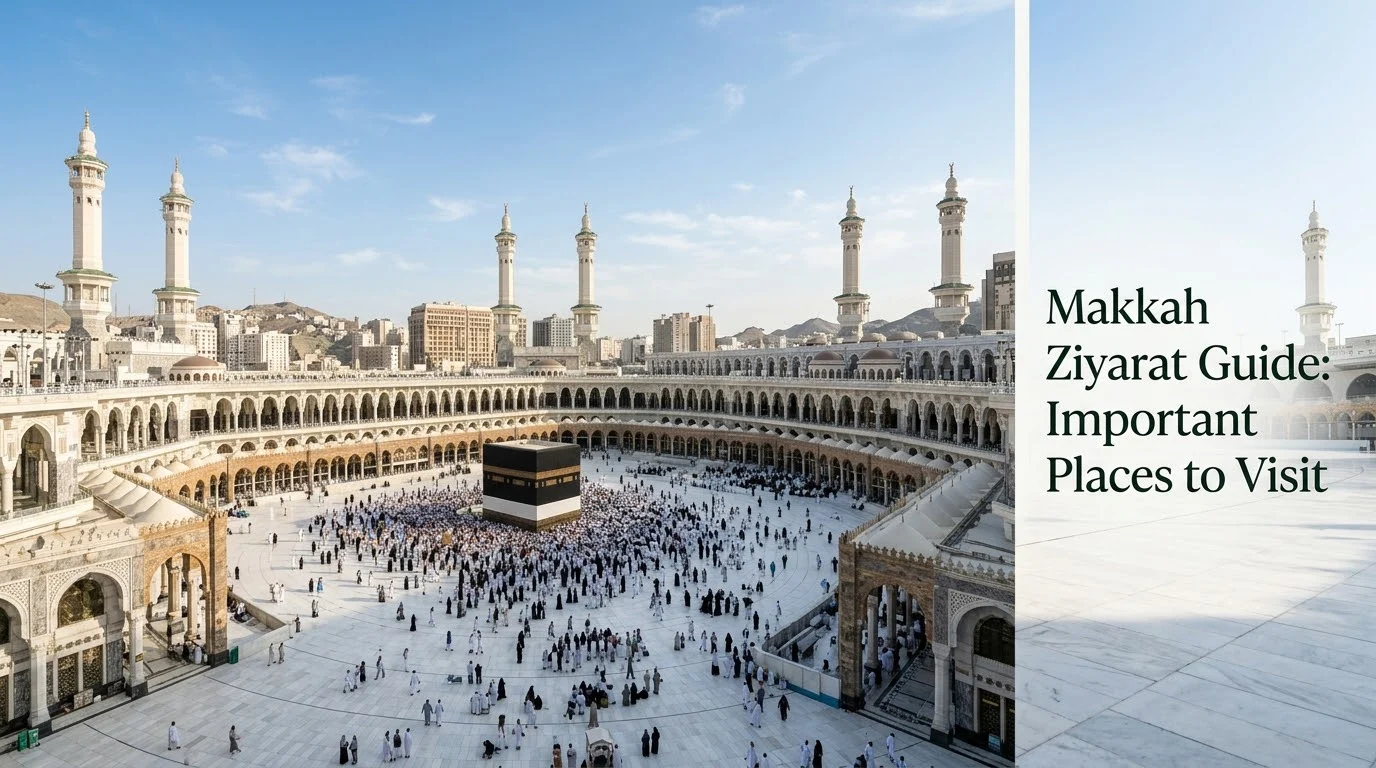
Featured image: AI Visualization / Illustration — not a photograph.